
As the world shifts towards more sustainable energy sources, renewable energy technologies, particularly offshore wind farms, are becoming key players in the global transition. Offshore wind farms, which harness the power of ocean winds to generate clean electricity, require innovative underwater construction techniques to bring them to life. These large-scale projects involve constructing platforms and turbines deep beneath the ocean’s surface, demanding precision engineering and cutting-edge technology.
In this article, we’ll explore the underwater construction processes involved in building offshore wind farms, and how these projects contribute to the growth of renewable energy while minimizing their environmental impact.
The Growing Importance of Offshore Wind Farms
Offshore wind farms are increasingly viewed as a vital part of the future of renewable energy. By utilizing the vast, untapped energy resources of the oceans, offshore wind farms can provide a reliable and sustainable energy supply. According to the Global Wind Energy Council, offshore wind capacity is expected to grow substantially in the coming years, with numerous countries investing in offshore wind projects as part of their climate action plans.
However, constructing offshore wind farms comes with several challenges, many of which involve underwater construction. These wind farms are typically located in deep waters, far from land, where they can harness stronger and more consistent winds, making the development of specialized underwater technologies crucial to their success.
Key Underwater Construction Techniques for Offshore Wind Farms
Building offshore wind farms involves several complex underwater construction techniques. Here are some of the main processes that engineers use to construct these renewable energy projects:
1. Site Assessment and Seabed Preparation
Before any construction begins, engineers conduct a thorough assessment of the seabed where the wind farm will be installed. This process involves geological surveys, seabed mapping, and environmental assessments to ensure the site is suitable for the wind farm’s foundations.
- How It’s Done: Specialized underwater vehicles like remotely operated vehicles (ROVs) and autonomous underwater vehicles (AUVs) are used to explore the ocean floor. These devices are equipped with high-definition cameras, sonar, and other sensors to assess the seabed’s structure, depth, and stability.
- The Challenge: The seabed must be stable enough to support large wind turbine foundations, and the area must be clear of underwater obstacles such as rocks or shipwrecks. The environment must also be assessed to understand how construction will impact local marine life.
2. Foundation Installation
The next step in offshore wind farm construction is the installation of the foundations that will support the wind turbines. There are several different types of foundations used for offshore wind farms, including monopiles, jackets, and floating platforms.
- Monopile Foundations: These are large, single cylindrical steel tubes driven into the seabed. They are used in shallow waters where the seabed is hard enough to support the structure.
- Jacket Foundations: These are more complex, multi-legged structures that are used in deeper waters. Jacket foundations are fabricated on land, transported offshore, and installed with specialized vessels and underwater construction techniques.
- Floating Foundations: In the deepest waters, where traditional foundations are not feasible, floating platforms are used. These structures are anchored to the seabed by long mooring lines, allowing the turbines to float in place.
- How It’s Done: The installation of these foundations involves the use of heavy-duty cranes, barges, and installation vessels, which transport the structures to the construction site. Once in position, the foundations are secured using pile-driving techniques, grouting, or other anchoring methods.
- The Challenge: Installing foundations in deep or turbulent waters requires precision, as the structures must be placed accurately and securely to withstand strong winds and waves over the long term.
3. Turbine Installation
Once the foundations are in place, the next step is to install the wind turbines themselves. Offshore wind turbines are massive, with blades often spanning over 100 meters in length, requiring highly specialized equipment to lift and position them accurately.
- How It’s Done: The turbine components, including the nacelle (the part that houses the generator) and blades, are assembled on the foundation in stages. Heavy-lift vessels are used to transport and position the turbine components. Once the turbine is assembled, it is connected to the power grid through subsea cables that transmit electricity from the wind farm to the shore.
- The Challenge: Offshore wind turbines must be resistant to harsh marine conditions, including saltwater corrosion and extreme weather. The assembly and installation process requires a large team of engineers, divers, and technicians to ensure the turbine is securely anchored and properly connected.
4. Underwater Cabling and Power Transmission
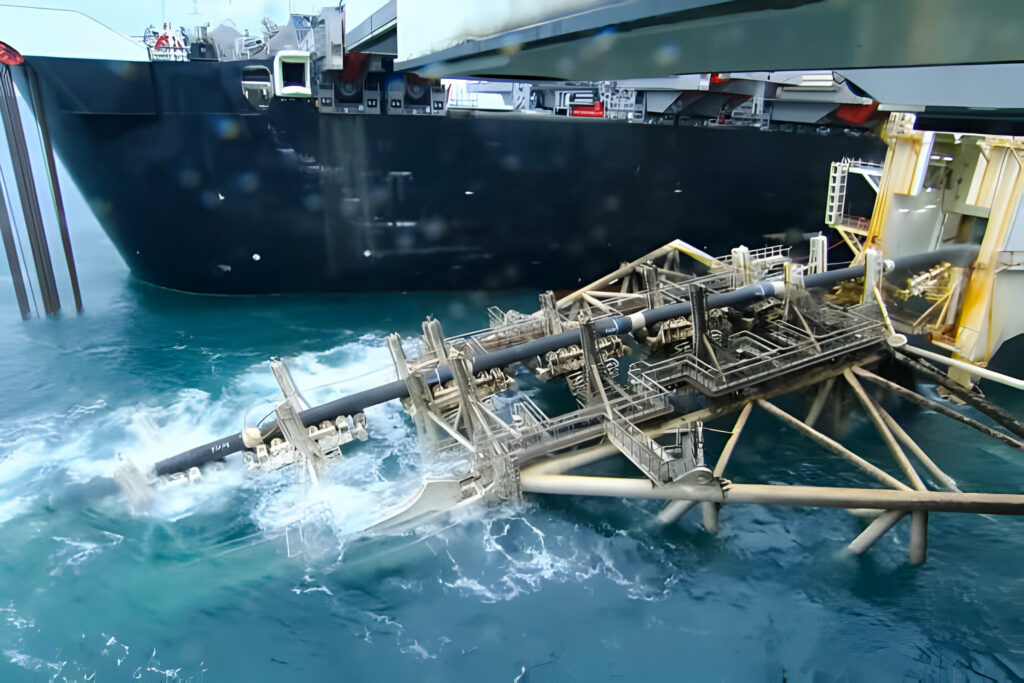
One of the final stages of offshore wind farm construction is laying subsea cables to connect the turbines to the power grid. These cables are responsible for transmitting the electricity generated by the turbines to land-based stations, where it can be distributed for use.
- How It’s Done: Specialized cable-laying vessels, equipped with dynamic positioning systems, are used to place and bury the cables on the seabed. These vessels use ROVs to inspect the installation and ensure the cables are securely positioned and protected from damage.
- The Challenge: The cables must be laid in a way that minimizes the risk of damage from underwater currents, fishing activities, or ship anchors. In some cases, cables are buried beneath the seabed to protect them from external threats.
Environmental Considerations and Mitigating Impact
While offshore wind farms contribute to the reduction of carbon emissions and offer a cleaner energy alternative, they must be constructed with careful consideration for the surrounding marine environment. Construction activities can impact local wildlife, and special care must be taken to minimize any adverse effects on the marine ecosystem.
- How It’s Done: Environmental impact assessments are conducted at every stage of construction to ensure that the wind farm does not harm local marine life. Techniques like bubble curtains are used to minimize noise pollution from pile driving, and monitoring systems are put in place to track the health of surrounding ecosystems.
- The Challenge: The installation of large structures in the ocean can disrupt marine habitats, potentially affecting fish, birds, and other species. Engineers and environmentalists work together to ensure that any impact is minimized and that marine life is protected during and after construction.
The Future of Underwater Construction for Renewable Energy
The development of offshore wind farms and other renewable energy infrastructure is a critical part of the fight against climate change. As technology advances, underwater construction techniques will continue to evolve, allowing for more efficient, sustainable, and cost-effective projects. Floating wind farms, which can be deployed in deeper waters, represent a particularly promising future, expanding the possibilities for wind energy generation.
As renewable energy plays an increasingly vital role in global energy production, underwater construction professionals will continue to push the boundaries of innovation, ensuring that offshore wind farms and other renewable energy projects are built safely, efficiently, and sustainably.
Conclusion
Offshore wind farms represent one of the most promising avenues for expanding renewable energy production in the coming decades. The underwater construction involved in creating these massive energy-generating systems requires advanced engineering, specialized techniques, and a careful consideration of environmental impacts. As the industry continues to grow and evolve, we can expect more exciting developments in underwater construction, contributing to a cleaner, more sustainable future for all.